Introduction: What Are You Missing When You Compare Cars?
When you set out to compare cars, where does your research typically go? For most, it’s a deep dive into specifications: horsepower figures, fuel economy, EV range, and the checklist of tech features. While these metrics are important, this standard method of comparison overlooks a fundamental factor that dictates daily usability, comfort, and satisfaction—the physical size and presence of the vehicle.
Too often, buyers only grasp the reality of a car’s dimensions upon delivery. The SUV feels towering and intimidating; the sleek coupe is surprisingly cramped; the hatchback has more bulk than anticipated. This disappointment stems from a critical flaw in how we compare cars: we rely on numbers to describe a quality that is inherently visual. Millimeters and inches cannot be intuitively translated by the human brain into a sense of scale.
This gap in understanding is exactly why a new approach is essential. The most effective way to compare cars for size is not to list their measurements, but to show them. This is the core of visual car comparison, and it transforms a confusing numerical task into an instant, intuitive revelation.
Jushify’s Car Size Comparison Tool is engineered for this purpose. It replaces the mental gymnastics of interpreting specs with a simple, scalable visual chart, allowing you to compare cars side-by-side with clarity and confidence. This is how modern car research should be done.
Car Size Comparison Tool
Why It’s Crucial to Compare Cars Visually, Not Just Numerically
A vehicle height of 1,650 mm is a precise datum, but without context, it is an abstract concept. The human mind excels at relative comparison, not at conjuring exact dimensions from text. When you compare cars visually, you engage this innate cognitive strength.
Visual comparison delivers immediate understanding. It shows proportions, stance, and overall bulk in a way a spec sheet never can. It eliminates the guesswork and mental conversion, presenting information exactly as you would perceive it in a parking lot or showroom. This method answers the real question you have: “How big is this car really, especially next to that other one I’m considering?”
Jushify’s tool applies this proven visual logic, already trusted in our Height Comparison and Phone Size Comparison tools, to the automotive world. It’s not just another database; it’s a visual decision-making engine designed to help you compare cars the way your brain naturally wants to.
How to Compare Cars with Jushify’s Tool: A Step-by-Step Guide
The tool is built for both simplicity and powerful flexibility, making it effortless to compare cars from any segment or era.
Step 1: Select from an Extensive Car Library
Instantly compare cars from a vast and growing database of makes and models. Our library includes everything from everyday brands like Toyota, Honda, and Ford to luxury and performance marques like Audi, Porsche, Tesla, Lamborghini, and Ferrari. Each entry comes with verified height data, ensuring your visual comparison starts on a foundation of accuracy.
Step 2: Upload Custom Car Images for Ultimate Flexibility
What if the car you want to compare isn’t in a standard database? Our custom upload feature is the solution. Perfect for classic cars, modified vehicles, regional models, or upcoming releases, this function allows you to:
- Upload any car image.
- Use the precision cropping tool to align the vehicle perfectly.
- Input its exact height measurement.
The tool then integrates your custom car seamlessly into the visual chart, allowing for a true apples-to-apples (or trucks-to-coupes) comparison.
Step 3: See the Difference Instantly on a Scalable Chart
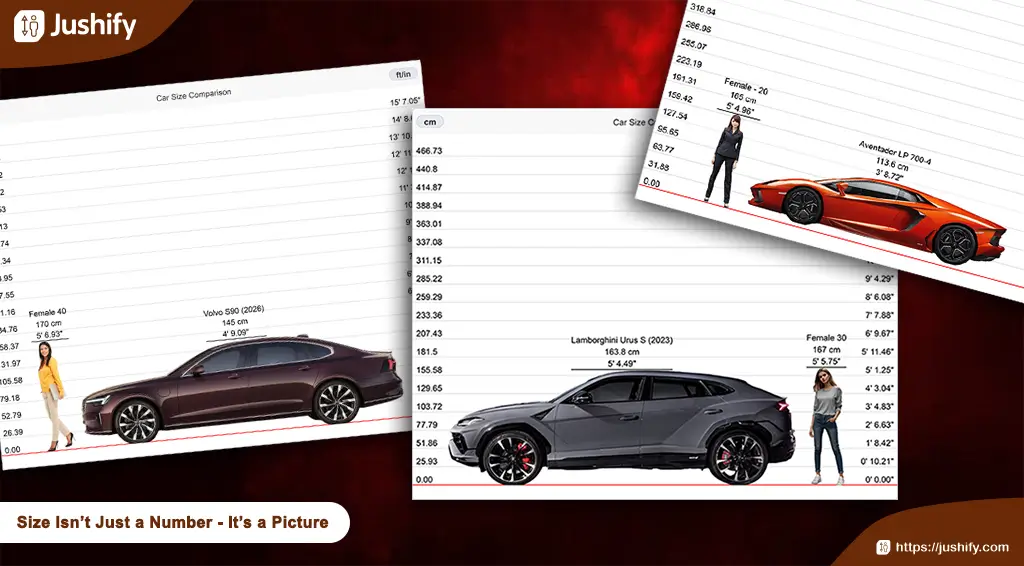
This is where understanding becomes effortless. The selected vehicles are displayed side-by-side on a calibrated height chart. You immediately see which car is taller, how significant the difference is, and how their proportions contrast. It turns the complex task to compare cars across segments into a simple, visual statement.
Compare Cars with a Human Element for Real-World Context
A vehicle’s relationship to human scale is perhaps the most practical yet overlooked metric. Jushify’s tool lets you add one or multiple human figures of customizable height to the chart. This allows you to compare cars not just to each other, but to life itself.
Ask and answer practical questions:
- How high is the roofline relative to a passenger?
- Is the door height suitable for easy entry and exit?
- Does the vehicle’s bulk feel commanding or approachable?
Adding this human context brings critical factors like accessibility, ergonomics, and safety perception directly into your comparison process.
Who Should Use Car Size Comparison?
- Car Buyers & Shoppers: Eliminate the “size surprise” before you sign any paperwork. Perfect for deciding between a sedan and an SUV, a compact vs. midsize crossover, or an EV versus its gasoline counterpart.
- Automotive Enthusiasts: Satisfy your curiosity. Compare cars across decades to see how design and proportions have evolved, or stack up rivals from different brands in a purely visual showdown.
- Families & Practical Drivers: Assess family-friendly features visually. Understand door accessibility, trunk/hatch height, and overall footprint to ensure the car fits your life, not just your garage.
- Industry Professionals & Students: A valuable resource for designers, marketers, and students to visualize market segments, study design trends, and communicate concepts clearly without relying solely on technical data.
Key Advantages: Why This is the Best Way to Compare Cars
- Cross-Brand Comparison Without Bias: Compare cars from any manufacturer on a level playing field. The visual chart shows only size and proportion, free from brand marketing or specification spin.
- Essential for the EV Era: Electric vehicles often feature unique proportions due to battery placement. Use the tool to understand how an EV’s height and cabin space compare visually to traditional vehicles.
- Professional-Grade Features: Enjoy auto-scaling charts, unit toggling (metric/imperial), full-screen mode for presentations, and easy sharing capabilities. This is a robust tool built for both casual and professional use.
- Informs Smarter Decisions: By integrating visual size comparison into your research, you build a more complete understanding of your options, leading to greater long-term satisfaction and no regrets.
Conclusion
To truly compare cars is to understand them in context. Specifications tell only part of the story. True clarity comes from visualization. Jushify’s Car Size Comparison Tool bridges the gap between abstract data and real-world understanding, empowering you to make confident, informed decisions.
Stop translating numbers and start seeing the difference. The most intelligent way to compare cars is right before your eyes.
👉 Experience the new standard in automotive research: Use the Car Size Comparison Tool today.
Unlike traditional spec sheets, our visual tool lets you see vehicles side-by-side on a scaled chart, so you can instantly understand their true size, height, and proportions—no more guessing from numbers alone.
We use verified vehicle height data for all cars in our library. For custom uploads, accuracy depends on the height value you provide and precise cropping, but when done correctly, it delivers a highly reliable visual comparison.
Yes. You can add customizable human figures to any comparison, helping you gauge real-world elements like roofline height, ease of entry, and overall vehicle presence relative to a person.